Welcome to Jain Irrigation Systems Ltd.

Welcome to Jain Irrigation Systems Ltd.
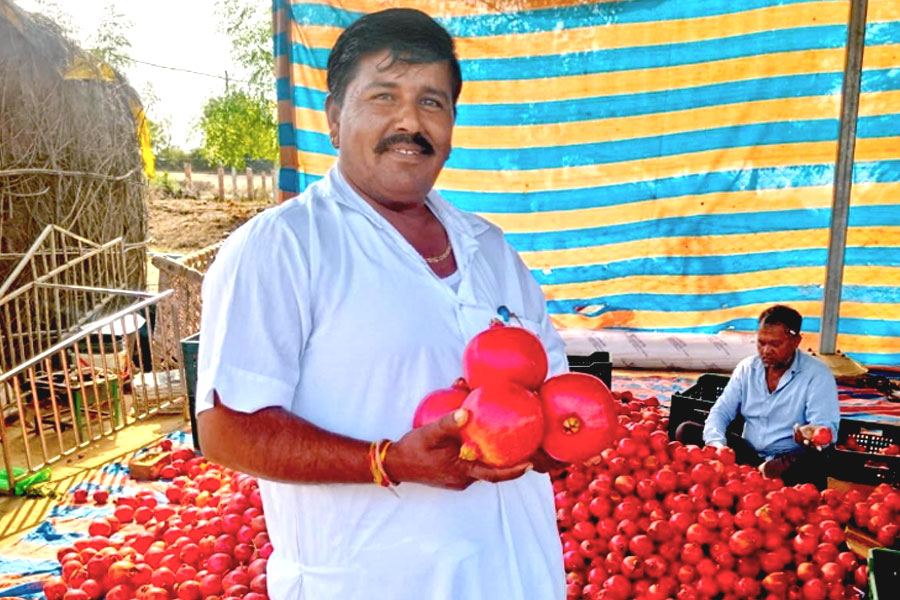
In the Jalore district of Rajasthan, where sandy soil, scanty rainfall and searing heat have long made farming feel like a gamble, a fifth-pass farmer from Dudhwa village has achieved what few around him thought possible. Naringaram Malaramji Choudhary, who once earned barely ₹50,000 a year from wheat, pearl millet and castor, now earns ₹1.68 crore from pomegranate cultivation. His fruit is graded for export and his orchard has become a model of modern horticulture in the region.
This transformation did not come from luck. It came from a single, well-considered decision. Jain Tissue Culture Bhagwa pomegranate plants, Jain Drip Irrigation and fertigation technology changed the entire picture of his farm. Here is his story.
Naringaram’s formal education ended at the fifth standard. He grew up working on the family farm and watched his ancestors practise traditional farming up close. For a household of eight, farming was the only source of livelihood, and it brought in just ₹50,000 to ₹1.5 lakh a year.
His resources were limited, but his thinking was not. Naringaram believed that if a farmer adopted new technology and modern practices, farming could be made far more profitable. With that conviction, he formed a group of progressive farmers and began travelling across different states of India to understand advanced cultivation.
My education may have ended at the fifth standard, but I always wanted to do something new in farming and to find better opportunities.
During these travels, he got the chance to visit Gujarat, where he saw pomegranate orchards developed under Jain Irrigation’s guidance for the first time. The excellent fruit quality, the healthy plants and the financial progress of those farmers left a deep impression on him.
Inspired, he travelled directly to Jain Irrigation in Jalgaon. There he studied tissue culture plants, drip irrigation and the fertigation system closely. Seeing successful pomegranate cultivation on the company’s demonstration plots convinced him that, with the right technology and guidance, pomegranates could be grown in his own region too. Before finalising his decision, he visited Jain Irrigation three times, held detailed discussions with experts and understood every aspect of pomegranate farming.
The path was not easy. Naringaram’s parents and many fellow farmers were against the decision. They believed pomegranates could never succeed in sandy soil and a harsh climate. But the demonstration plots, along with detailed discussions with agricultural scientists and agronomists, strengthened his confidence further. That resolve turned out to be the most important turning point of his life.
I had decided that if I wanted to bring change to my farming, I would have to take the risk.
On 21 February 2020, Naringaram planted 3,500 Jain Tissue Culture Bhagwa pomegranate plants on 10 acres at a spacing of 13 × 9 ft, along with 6,500 air-layered (gooti) plants. For precise water management, each plant was fitted with six drippers, two lateral lines were laid per row and the dripper discharge was set at 4 litres per hour. Combined with Jain’s fertigation system, this supplied water and nutrients to the plants exactly as needed.
Today, all 40 acres of his farm run on 100% Jain Drip Irrigation.
The initial investment may be a little higher, but once installed, the maintenance cost is almost negligible. The quality of the pipes and fittings is so good that they work for years without any trouble.
Within a few months, the difference between the tissue culture and gooti plants became clear. The Jain Tissue Culture plants were healthier, greener and far more uniform in growth. About two and a half years later, in July 2022, the first harvest began, and the income graph started climbing from there.
First Harvest (2022): Around 30 tonnes of production, about 8.5 kg per plant. Income of roughly ₹28 lakh against a cost of ₹17.5 lakh.
Second Harvest (2023): Production rose to about 90 tonnes, around 25.7 kg per plant. Income of roughly ₹75 lakh against a cost of about ₹20 lakh.
Third Harvest: Both yield and quality set new records, with an average of about 40 kg per plant. Income reached roughly ₹1.68 crore, while the cost stayed at around ₹20 lakh.
Where a full year of effort once brought in ₹50,000 to ₹1.5 lakh, a single acre of pomegranate now delivers a net profit of about ₹14.8 lakh.
The pomegranates from Naringaram’s orchard have been of outstanding quality from the start. Their colour, size, shine, weight and internal quality were good enough for his produce to be selected for export. At a time when the local market price was around ₹100 per kg, his export-grade fruit sold for ₹175 per kg. Notably, even the fruit that was not selected for export, the reject grade, sold at a healthy ₹100 per kg in the local market.
This was not just a financial success. It was proof that when a farmer focuses on quality, the market rewards it with a better price.
Encouraged by the first harvest, Naringaram expanded his orchard further in 2021 and 2022. Today, his plants, now 5 to 6 years old, remain fully healthy and green. To protect the plants from disease, he has regularly used neem-based products and neem cake from the very beginning, which improved their disease resistance and reduced his dependence on chemical sprays.
Challenges in farming never truly end. Last year, the region received heavier rainfall than usual, raising the risk of waterlogging and disease. But drip irrigation, careful water management and the well-draining sandy soil kept the situation fully under control.
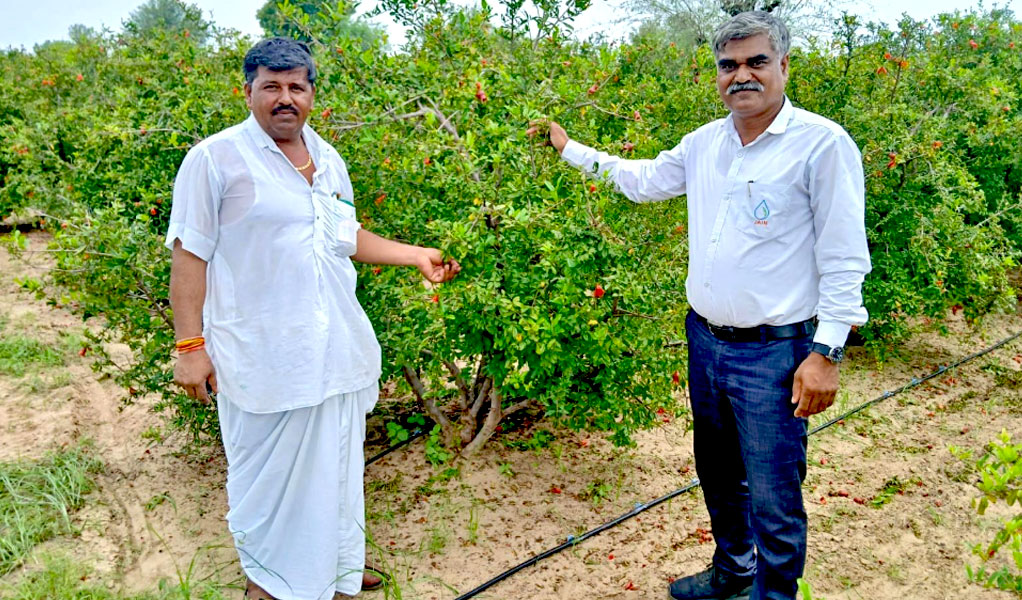
The income from pomegranate cultivation completely changed the picture for Naringaram’s family. He invested continuously in the farm, expanded the orchard and adopted modern management. On the strength of those profits, he built a modern house for his family and bought nearly 100 bighas of additional farmland.
My greatest joy is that the children who once studied in the village with limited opportunities are now getting higher education in cities like Jodhpur and Delhi. That is a bigger happiness than any financial achievement.
Drawing on his own experience, Naringaram has one firm message for every pomegranate farmer. If you want higher yields and superior quality at a lower cost, begin with Jain Tissue Culture Bhagwa pomegranate plants. In his view, most diseases enter the field through cheap gooti plants, whereas Jain Tissue Culture plants are free from oily spot disease, wilt and nematodes.
Many farmers try to save a little money at the start but end up losing their entire crop. The money saved in the beginning often leads to much bigger losses later.
He also believes that success does not come from good planting material alone. Proper plant training and pruning, sound water management, crop cooling and crop covers suited to changing weather, effective pest and disease management, fruit covers to protect against sunburn, and stage-wise fertigation all come together to make pomegranate farming successful.
Naringaram considers the contribution of the Jain Irrigation team central to his entire journey. From plant selection to orchard establishment, drip irrigation, fertigation, scientific techniques, timely technical guidance and protection from fake consultants, Jain’s agronomist Chetan Gulve and the team supported him at every step.
Where I stand today is the result of my own hard work together with Jain Irrigation’s technology, quality and dedicated team.
Standing on the sandy soil of Jalore, Naringaram Choudhary’s lush green orchard is a message to every farmer: with the courage to embrace change, trust in modern technology and a commitment to quality inputs, the possibilities in farming are limitless.