Welcome to Jain Irrigation Systems Ltd.

Welcome to Jain Irrigation Systems Ltd.
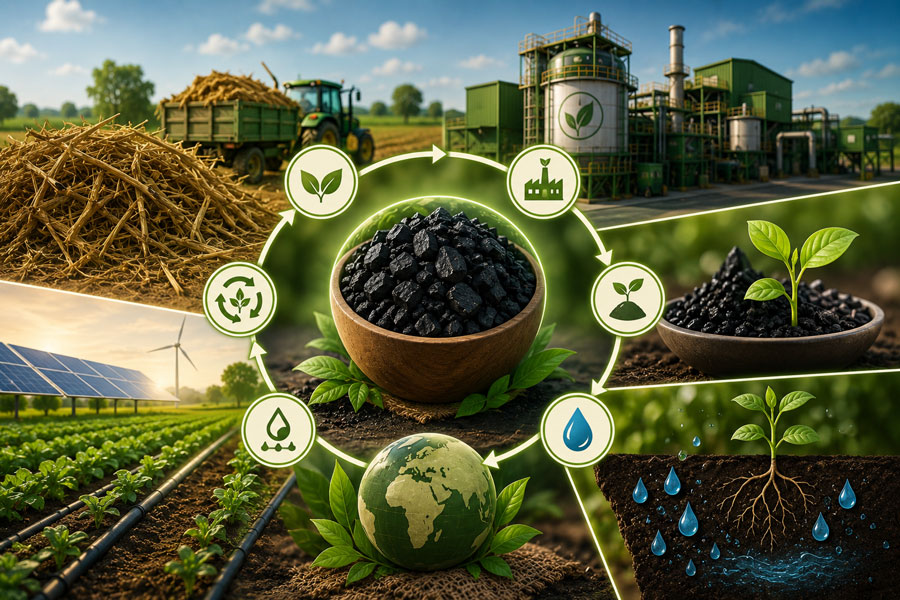
Jain Irrigation Systems Ltd. (JISL) — the world’s largest micro-irrigation systems provider and a global leader in sustainable agriculture — has commissioned a ~20,000 tonne/annum high-tech industrial-scale biochar facility along with its partners in Jalgaon, Maharashtra, advancing climate-smart agriculture, circular manufacturing, and engineered carbon removal at commercial scale. JISL has worked with global experts in the field to design and implement this pioneering project.
With a processing capacity of more than 50 metric tonnes of agricultural and fruit processing residue per day, the Jalgaon plant stands among the world’s largest single-unit biochar reactors, placing India at the forefront of the global biochar and carbon removal movement.
The Jalgaon plant is the first of multiple biochar reactors, with additional units already under development.
Biochar is a stable, carbon-rich material produced through pyrolysis, where agricultural crop residue is heated in a low-oxygen environment. Unlike the unsustainable disposal or open burning of crop residue — which contributes to emissions — converting this residue into biochar stores carbon in a durable form for hundreds of years while simultaneously improving soil health. It is widely regarded as one of the most credible and durable forms of carbon dioxide removal (CDR).
This project brings to life a powerful farm-to-soil circular economy: crop residues once treated as waste are converted into premium biochar and returned to farmers’ fields to improve soil fertility, enhance water retention, and strengthen climate-ready agriculture. By creating value from agricultural residue, the project opens new income streams for farmers, lowers dependence on synthetic inputs, and advances a regenerative model where productivity, profitability, and sustainability reinforce each other.
Critically, JISL’s existing infrastructure across micro-irrigation, planting material, agri-food processing, and solar systems — and its deep distribution network reaching millions of farmers — creates a ready-built channel to return biochar directly to farms at scale. No other biochar producer in India has this last-mile advantage.
India generates over 500 million tonnes of crop residue annually, much of which is openly burned. The JISL facility transforms this challenge into a multi-layered economic opportunity:
The JISL biochar project delivers durable, measurable, and verifiable carbon dioxide removal credits supporting permanent carbon sequestration for hundreds of years, reducing stubble burning, enriching soil carbon, and improving water-use efficiency.
Congratulations to Jain Irrigation on building a significant biochar production output and commissioning a new facility, reflecting the scale and kind of leadership CDR needs. We’re proud to support Jain Irrigation as it advances on its certification journey with a clear commitment to quality and rigour. Biochar is especially relevant for agricultural economies across Asia, with the potential to deliver durable carbon removal alongside wider benefits for soil health, water retention, and reduced fertilizer dependency. — Mr. Alvin Lee, Head of Supply, Puro.earth – Global Carbon Removal Registry
This is a proud and important milestone for us. At Jain Irrigation, ‘Creating shared value’ has always been at the heart of everything we do. This project goes beyond technology; it is about reimagining the agriculture value chain. By turning agricultural residue into a valuable resource, we are creating a circular system that benefits the farmer and all other stakeholders. — Mr. Anil Jain, Managing Director, Jain Irrigation Systems Ltd.
Jain Irrigation Systems Ltd. (NSE: JISLJALEQS | BSE: 500219) has worked with over 10 million farmers and is the world’s largest micro-irrigation systems provider.
JISL is an Indian multinational with revenues of USD 750 million, operating manufacturing plants across 22 global locations and employing over 9,000 associates worldwide. The company operates across irrigation, piping systems, HDPE & PVC pipes, agri-processed foods, renewable energy, plastic sheets, and tissue culture planting material — serving farmers for over four decades across more than 120 countries.
An early pioneer of IoT in agriculture and a leader in precision farming, JISL’s "More Crop Per Drop" approach has driven a productivity revolution for smallholder farmers globally. All JISL businesses are guided by its founding vision: "Leave this world better than you found it."