Welcome to Jain Irrigation Systems Ltd.

Welcome to Jain Irrigation Systems Ltd.

While designing a water supply scheme in areas having subzero temperatures during a certain time period, requirement to eliminate / minimize the heat losses during water flow, in circulation, the supply and return pipes becomes very crucial and important. The way you ensure that as little heat as possible escapes from pipes and the effectiveness of the method selected decides the effectiveness and longevity of uninterrupted system functioning. While doing so the installation and operational parameters become very important along with the overall cost of the system.
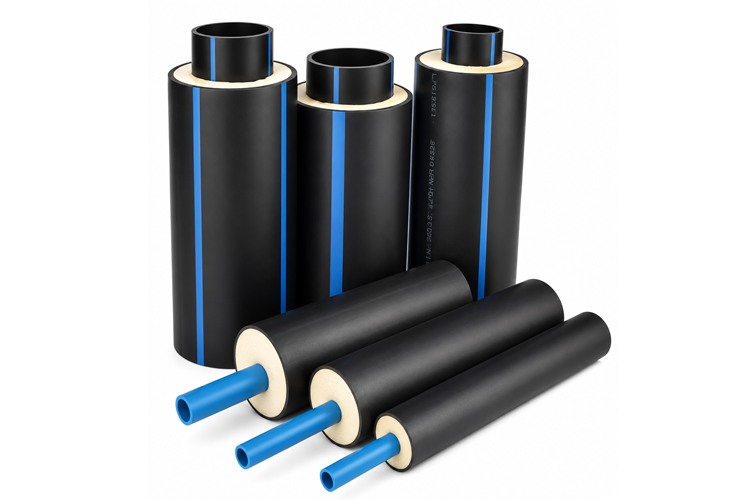
Introducing Jain PE insulayer Piping System used for installation of water piping network in areas reaching subzero temperature. The insulation of the Piping network is a very crucial subject to eliminate / minimize heat losses. Jain insulayer pipe is a three layer pipe made up of inner and out PE material and in between core is filled with polyurethane material.
The inner PE pipe is of standard diameter and required pressure class to meet the flow and head requirement. Middle polyurethane layer works as an insulator and limits the rate of heat transfer between the surrounding environment and the flowing fluid through the inner pipe. Outer PE layer works as a protective layer to insulation.
The appropriate insulation of hot- and cold-water pipes protects not only against heat losses, but also against mechanical damage. These result from friction against partitions under the influence of temperature changes in flowing water.
Pipe insulation protects not only against heat-escape, but also from condensation on the pipe’s surface in the event of cold-water flow. It prevents water-vapor condensation, and mold and fungi formation. Furthermore, in the case of outdoor systems, it prevents freezing, which leads to a blocking of the flow in the system.
Polyurethane-foam is used to insulate Jain Insulayer PE water pipelines. This material is resistant in the temperature range of around -60°C to 90°C, and has a low heat-transfer coefficient. Such a thermal insulator is rigid, and perfectly protects pipes from damage.